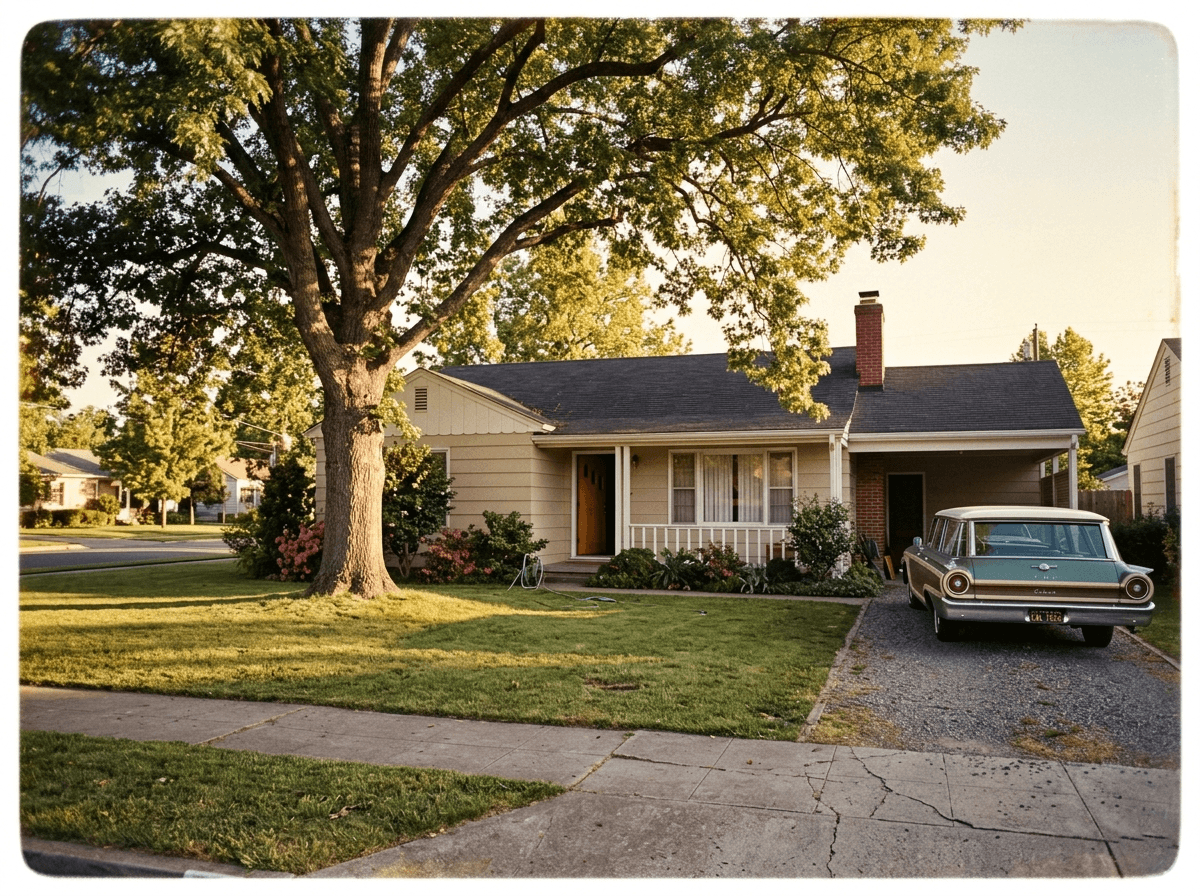
“I was seven years old when Dad loaded everything we owned into the back of that old station wagon.”
Listen to the sample story
Read the story excerpt
Mom wrapped the good dishes in newspaper and tucked them between pillows. My brother and I sat in the back seat with the cat between us, watching our old house get smaller and smaller through the rear window.
A living digital book
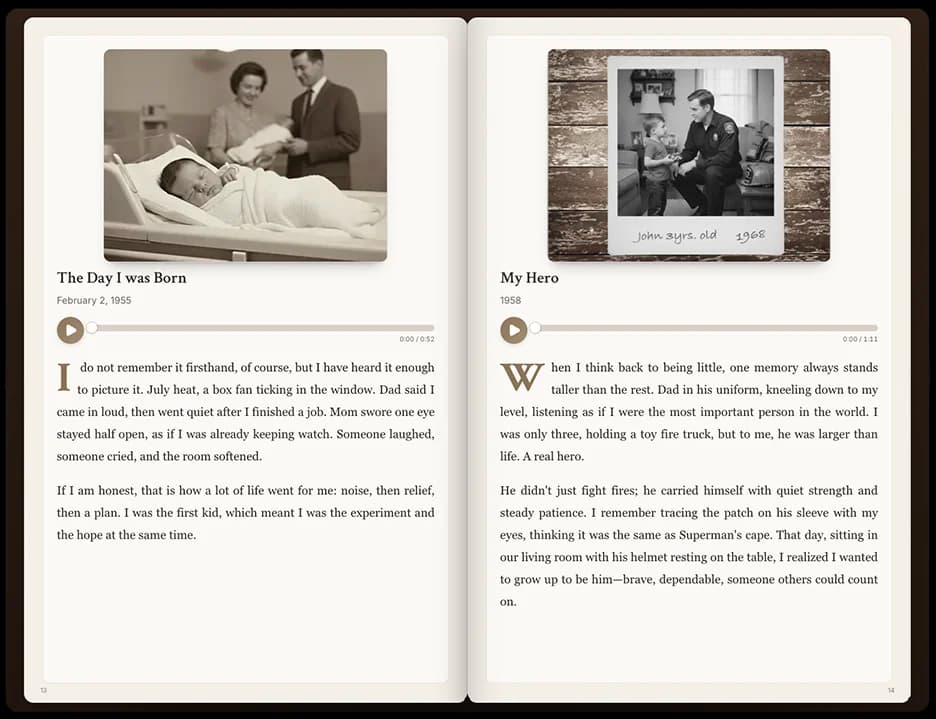
A place for the whole story.
Keep recordings, written stories, and family photos together. Add another memory whenever you're ready.
Demonstration content, not a customer testimonial. Digital keepsake shown.
The complete question collection
A life, chapter by chapter.
Start light. Follow the tangents. Tap + to keep any question for your conversation.
Quick answer
The best questions to ask your dad begin with childhood, then explore his family, friendships, and life before parenthood. Try “What's your earliest memory?” and “What was your dad like?” Ask follow-up questions, listen without rushing, and record only with permission.
Before You Begin: How to Use This List
Quick answer: Don't try to do them all in one sitting. Most fathers open up better through objects and specific events than through abstract feelings. Use the concrete questions as your way into the harder ones.
This list is organized from easy warmups (childhood, first car, favorites) to harder questions (regret, legacy, what he never said). Most dads talk more easily about what they did than how they felt — but if you ask the concrete questions first, the feelings come out on their own.
If your dad is older or has limited energy, run 30-45 minute sessions rather than one long interview. Families who record stories in shorter, recurring sessions capture significantly more content than those attempting marathons.³
His Childhood
Quick answer: Childhood questions are the safest warm-ups. Specific objects and places work better than abstract prompts.
His Father (Your Grandfather)
Quick answer: Questions about your dad's own father are some of the most overlooked — and the most revealing. They show where your dad learned to be a father, and what he chose to keep or change.
Why this matters: Research shows that children who know their family history have higher self-esteem and better resilience during stress.⁴ The father-to-father story is often where that thread starts — and where the silences in a family begin.
His Teen Years and Coming of Age
Quick answer: Teen years often hold the formative experiences that shaped the man — first jobs, first cars, first heartbreaks, the moment he started making his own decisions.
Military, Service, or What He Did in His 20s
Quick answer: For many dads of older generations, military service or the early-20s years are the chapter most likely to contain stories never told to family. Ask gently. Let him decide what to share.
If your dad served, this section may be the most important one in this entire list. Many veterans don't talk about service unless asked — and the stories they hold include both pride and pain. Move at his pace.
If he didn't serve:
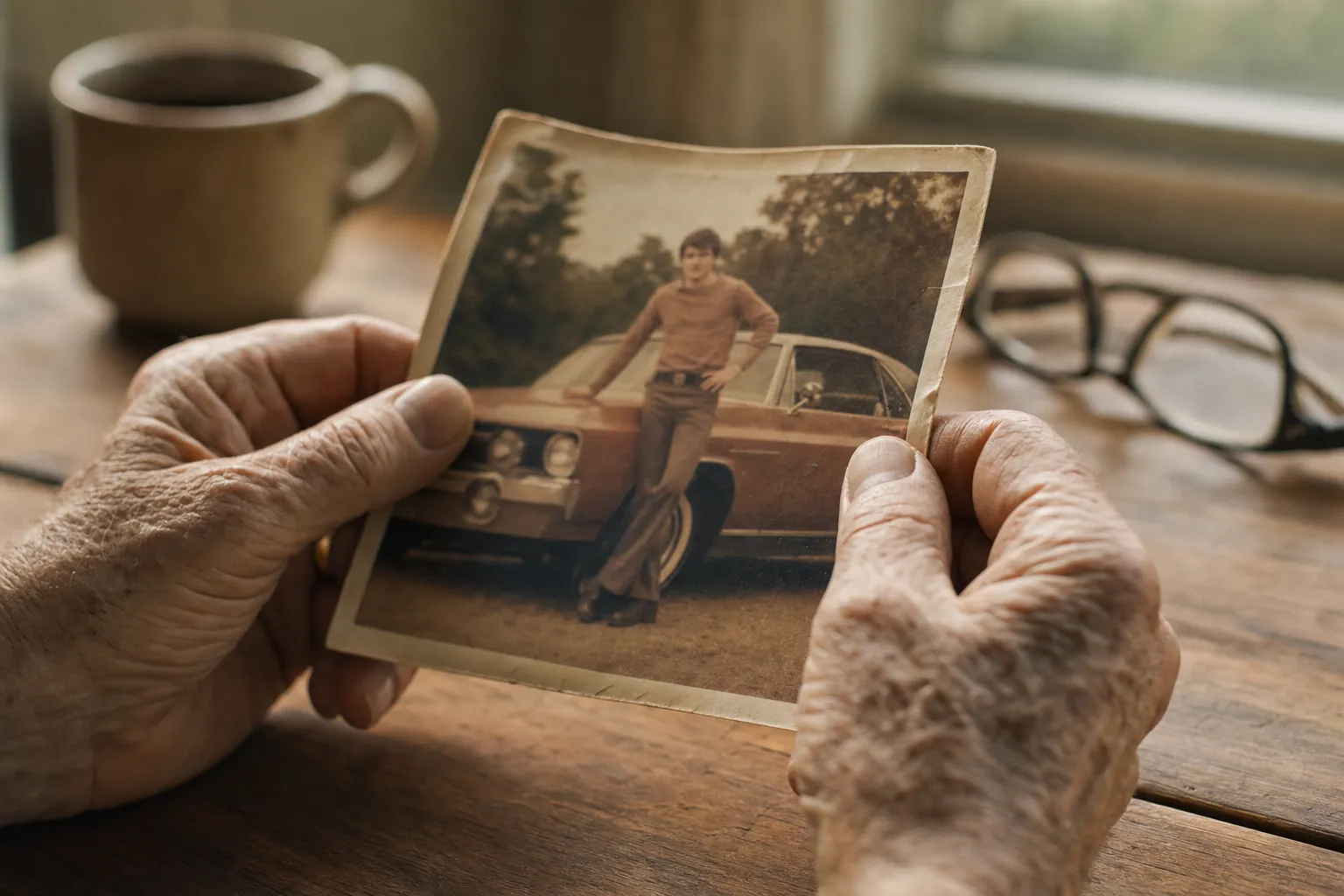
Every old photo holds a story he's been waiting to tell.
The Man Before "Dad"
Quick answer: This is the section most kids never ask about — and one many fathers most want to be asked. Who was he before kids? What did he want? What did he set aside, and what did he chase?
This section often produces the most surprising stories. From our experience, the prompt "what were you doing right before you became a dad?" is one of the most consistently emotional questions we've seen seniors record.
How He Met Your Mom (His Version)
Quick answer: Ask for his version of the love story. The version told by mothers and the version told by fathers are often very different — and both belong in the family record.
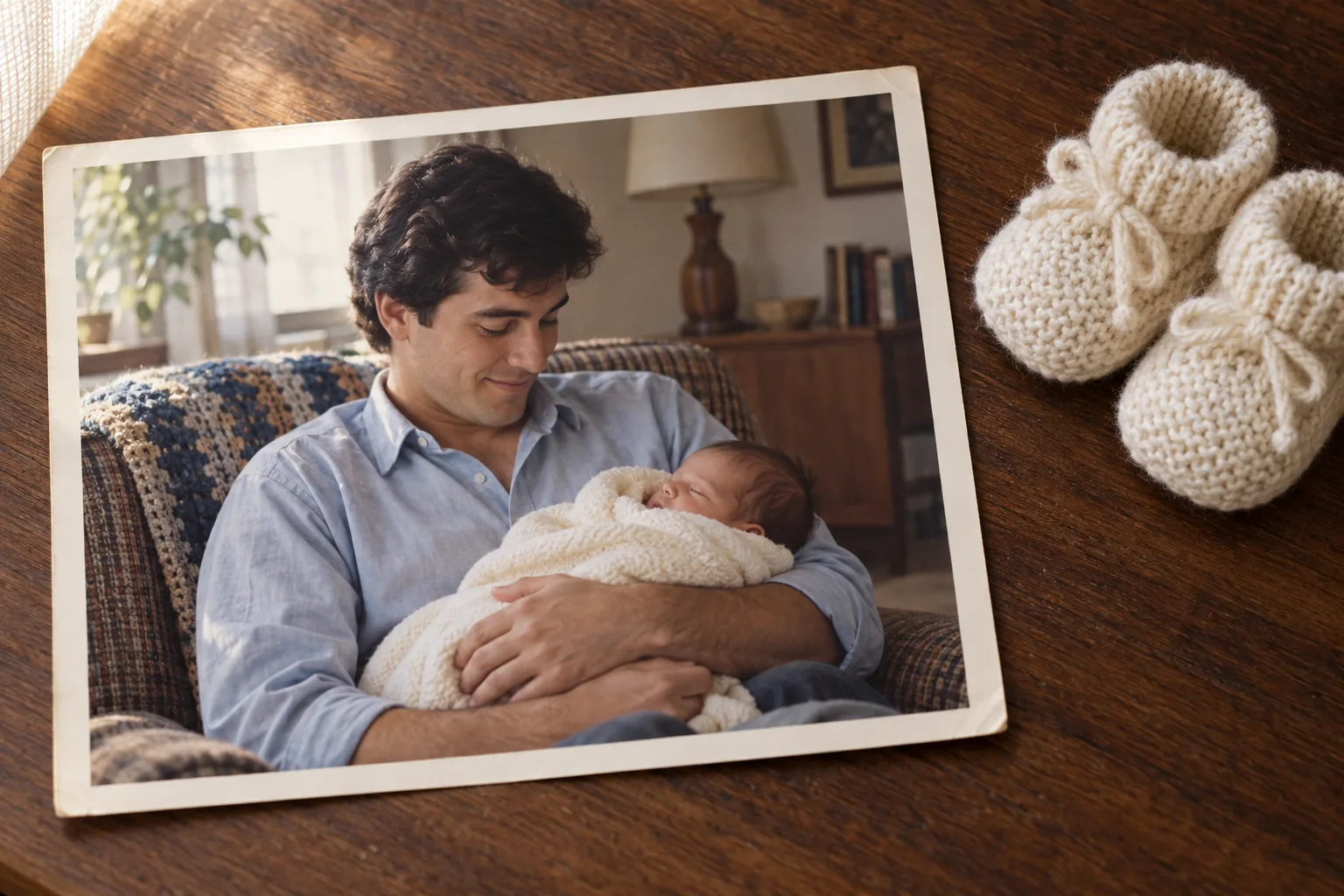
Ask him what he remembers about becoming your dad. Illustrative scene.
Becoming a Father (The Hidden Chapter)
Quick answer: Most kids never ask their dad about the day they were born from his perspective — they assume only the mother's story matters. It doesn't. Ask.
Career, Work, and Providing
Quick answer: For many dads, work was identity. These questions surface the choices, sacrifices, and hidden pride that built the family's stability.
His Friendships
Quick answer: Male friendships are often hard to maintain across decades. These questions surface the people in his life — the ones still here and the ones he lost.
His Loves: Hobbies, Cars, Music, Sports
Quick answer: Hobby and passion questions surface stories your dad loves to tell — and they're great cool-down questions after deeper sections.
Faith, Values, and What He Believes
Quick answer: These questions surface his inner life — the beliefs he's tested, the values he's certain of, what he's still working out.
Hard Times He Got Through
Quick answer: Don't avoid the hard chapters — handled gently, they're often the stories that show what your dad is made of, and the ones he most wants to tell.
Ask permission first: "Is it OK if I ask about a hard time? You can pass on anything." Then listen more than you talk.
About Me, From His Eyes
Quick answer: These are the questions whose answers your kids will play back the most — especially after he's gone.
Life Lessons and Wisdom
Quick answer: Save these for sessions where you have time and energy. They're the legacy questions.
Just for Fun
Quick answer: Light questions are perfect for cool-downs after deeper sections, or for quick conversations when energy is low.
The Father's Day Conversation: A 30-Minute Starter Set
Quick answer: If you only have one Father's Day window, ask these three questions in order. They're the fastest path to a recording your family will keep.
If you don't know where to start this Father's Day, here's the script:
"What was your first car? Tell me everything about it." — easy warmup, dads almost always have a story
"What was your dad like? What did he teach you that you still carry?" — opens the generational thread
"What was the day I was born like for you?" — almost always emotional, almost always the recording your siblings will replay
Hit record before question one. Don't worry about quality — phone audio is fine. Most families look back and wish they had any recording at all. Polish doesn't matter; presence does.
Tips for Asking These Questions
Quick answer: Start concrete, follow the tangents, record everything, and make it a series — not a one-time event.
Start concrete. First-car, first-job, and childhood questions are warmups that give your dad something specific to talk about. Save the harder questions for after he's relaxed into the conversation.
Follow the tangents. If a question sparks an unexpected story, follow it. The most meaningful family stories often emerge from unplanned tangents, not scripted questions.⁵
Record everything. Memories are precious, and memory fades roughly 50% within an hour without review.⁶ Don't trust your own memory.
Make it regular. You won't cover this list in one sitting, and you shouldn't try. Three 30-minute sessions will get you more than one two-hour marathon — and your dad will enjoy it more.
Ask follow-ups about objects. When he mentions a car, a tool, a place, ask, "What did it look like?" "What was that like?" Specific objects unlock the surrounding memory.
Don't push when he goes quiet. The pause often comes right before the most important story. Wait.
You have the questions. Now keep his answers forever.
It takes about twenty minutes and a phone. Heritage Whisper turns this conversation into a searchable family archive, transcribed for you and organized by chapter, shared instantly with everyone who matters. Years from now, your kids will still hear his voice answering these exact questions.
StoryCorps — 645,000+ participants since 2003, with sessions averaging 40 minutes
Emory University "Do You Know?" Study — Dr. Marshall Duke & Dr. Robyn Fivush: family history knowledge is the best single predictor of children's emotional health
Frontiers in Psychology — "The role of intergenerational family stories in mental health and wellbeing," 2022
Ebbinghaus Forgetting Curve — established psychology: memory fades approximately 50% within an hour without review
Frequently Asked Questions
What are the best questions to ask your dad?
Start with easy questions about his childhood and first car, then move into his father, his teen years, military or early work life, falling in love, and becoming a father. The most meaningful questions are about his own dad, the day you were born from his perspective, and what he never told you. Most fathers open up more easily about specific events — first car, first job, military experience — than about feelings. Use those as your way in.
What should I ask my dad for Father's Day?
Pick three questions you've never asked: one about his first car or first job, one about his own father, and one about the day you were born. Record the answers. Most adult kids report wishing they'd asked the simple questions: 'What was your dad like?' and 'What did you want to be at 25?' A 20-minute conversation captured this Father's Day becomes a recording your family will replay for decades.
How do I get my dad to open up?
Most dads talk more easily through specific objects and events than through emotions. Ask 'tell me about your first car' or 'what was your first job' rather than 'how did you feel.' Specific anchors unlock memory and feelings together. Avoid yes/no questions — they shut conversations down. And don't push when he goes quiet. The pause often comes right before the most important story.
What questions should I ask my dad before he dies?
Prioritize three areas: his own father (your grandfather), his version of how he met your mom, and the day you were born from his perspective. Then ask the question many men want to be asked but rarely are: 'What's something you've never told me that you want me to know?' Even a 15-minute recording on these areas creates irreplaceable family history.
Made by you. Ready to take along.
Your conversation with Dad.
Keep your favorite questions together, with follow-up prompts and room for notes. Free to save or print. No email needed.
0 questions selected
Your choices stay in this browser when storage is available. Save a copy to keep them.
The conversation notes
Ask permission before recording. Start gently. Any question can be skipped.