Quick answer
Good questions to ask a veteran begin with their life before service, joining, training, daily routines and friendships. Ask what they are comfortable discussing before recording. Let them skip topics, pause or stop; a meaningful interview does not need to include combat.
Before You Begin: A Conversation with a Veteran Parent
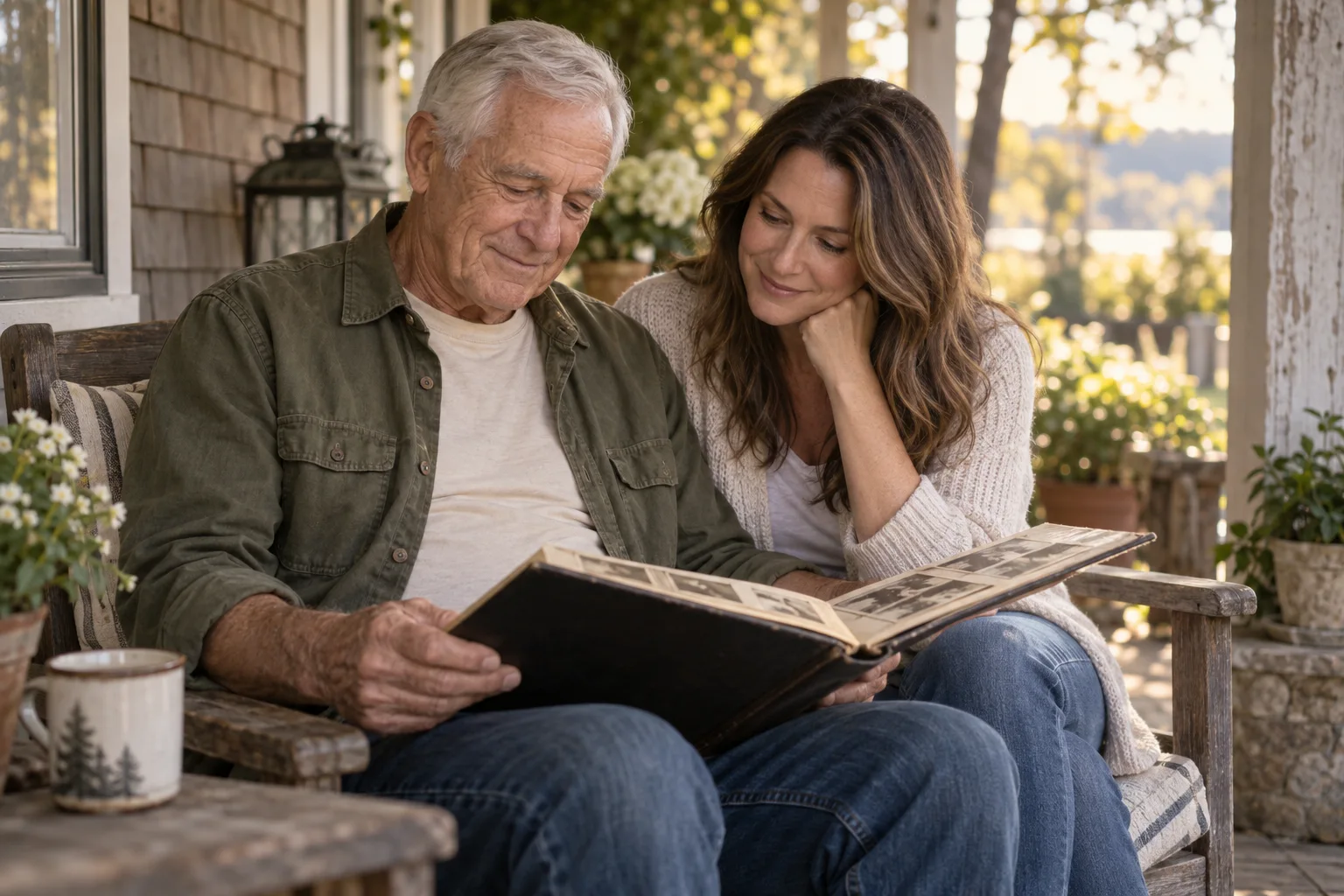
Ask your parent which parts of their service they would enjoy talking about. You might begin with a friend, a daily routine or the journey to their first posting. Family photographs can offer a natural starting point without asking them to retell their hardest experiences.
Agree on permission to record and who may hear the result. Any question can be skipped. Pause when they want to pause, and let them choose whether to continue. A meaningful service story does not have to include combat.
The free worksheet above is for a family conversation. It is not an official submission form. If you hope to contribute an interview to the Library of Congress, read the Veterans History Project participation requirements before recording. Its sample interview questions provide another useful reference. Our kit does not guarantee eligibility or acceptance into that archive.
Before You Begin: Why Veterans Don't Talk (and How to Invite Them)
Quick answer: Most veterans don't volunteer their stories — not because the stories aren't there, but because civilians have asked badly for decades. Specific, respectful questions change that.
Most veterans have been asked the same handful of questions their whole lives:
- "Did you kill anyone?"
- "Was it like the movies?"
- "What was the worst thing you saw?"
After enough of those, a lot of veterans simply stop talking about service at all. They learn that civilian audiences don't actually want the real story — they want the action-movie version, or they want to feel briefly noble for asking.
The questions that actually unlock stories are the small, specific ones: what was the food like? what did your bunk look like? who was the friend you'd have done anything for? Those questions tell a veteran that you want them, not the war.
A few principles before you start:
- Don't assume combat. Roughly two-thirds of all veterans never saw combat. Their service was real, full of stories, and worth recording — even if it doesn't fit a Hollywood script.
- Don't push when they go quiet. The pause is often the decision point about whether to tell you something hard. Wait.
- Don't substitute "thank you for your service" for listening to one. The phrase is a closing line; a question is an opening one.
- Record everything. Memory fades roughly 50% within an hour without review.⁴ Phone audio is fine.
- Run shorter sessions. Families who record stories in 30-45 minute sessions capture significantly more than those attempting marathons.⁵
This list is organized from easiest (how they ended up in service, basic training) to hardest (combat, losses, what they've never told anyone). Don't try to do them all in one sitting.
How They Ended Up in the Service
Quick answer: The decision to enlist or the experience of being drafted is one of the most overlooked story arcs. It often involves family expectations, economics, geography, and pure chance — long before any uniform was put on.
Basic Training and Boot Camp
Quick answer: Basic training is the most universal veteran experience — every branch, every era, every veteran has stories. It's the safest deep-warmup section.
His or Her Job, Unit, and Where They Served
Quick answer: Specifics unlock memory. Branch, MOS or rate, unit, ship, station — these are the anchors that surface the rest of the story.
The People You Served With
Quick answer: Many veterans say the people they served with mattered more than anything else — and many of those names go unspoken in families for decades. This section is the one that often surprises both of you.
Why this matters: Research on military bonds finds the unit cohesion experienced in service often becomes the most defining relationship of a veteran's life.⁶ Asking by name honors that.
Deployment, Combat, and the Hard Parts
Quick answer: Approach this section last and slowly. Don't ask if they don't want to go there. If they do, ask specifically — vague combat questions get vague answers (or none at all).
This is the section to slow down on. Some veterans want to talk about their deployment in detail; some want to mention it only in passing; some have spent fifty years not talking about it. Let them lead.
If they say they don't want to talk about something, stop and stay there. Don't backpedal awkwardly — just say "okay, I won't ask again." Then move to the next section. Trust they may come back to it later.
If they do want to talk:
Memorial Day Questions: The Ones We Lost
Quick answer: Memorial Day specifically honors those who died in service. The most meaningful question is who they remember — by name, if they're willing.
Memorial Day is not the same as Veterans Day. Veterans Day honors everyone who served. Memorial Day honors those who didn't come home.
For a veteran who lost someone:
For a veteran who didn't lose anyone in combat but lost brothers and sisters since (to suicide, illness, accident, or age):
- Who do you remember from those years?
- What's the name you'd want my kids to know?
- What's a story about him or her you want preserved?
Names and stories outlive grave markers. This is the recording your family will replay.
Coming Home
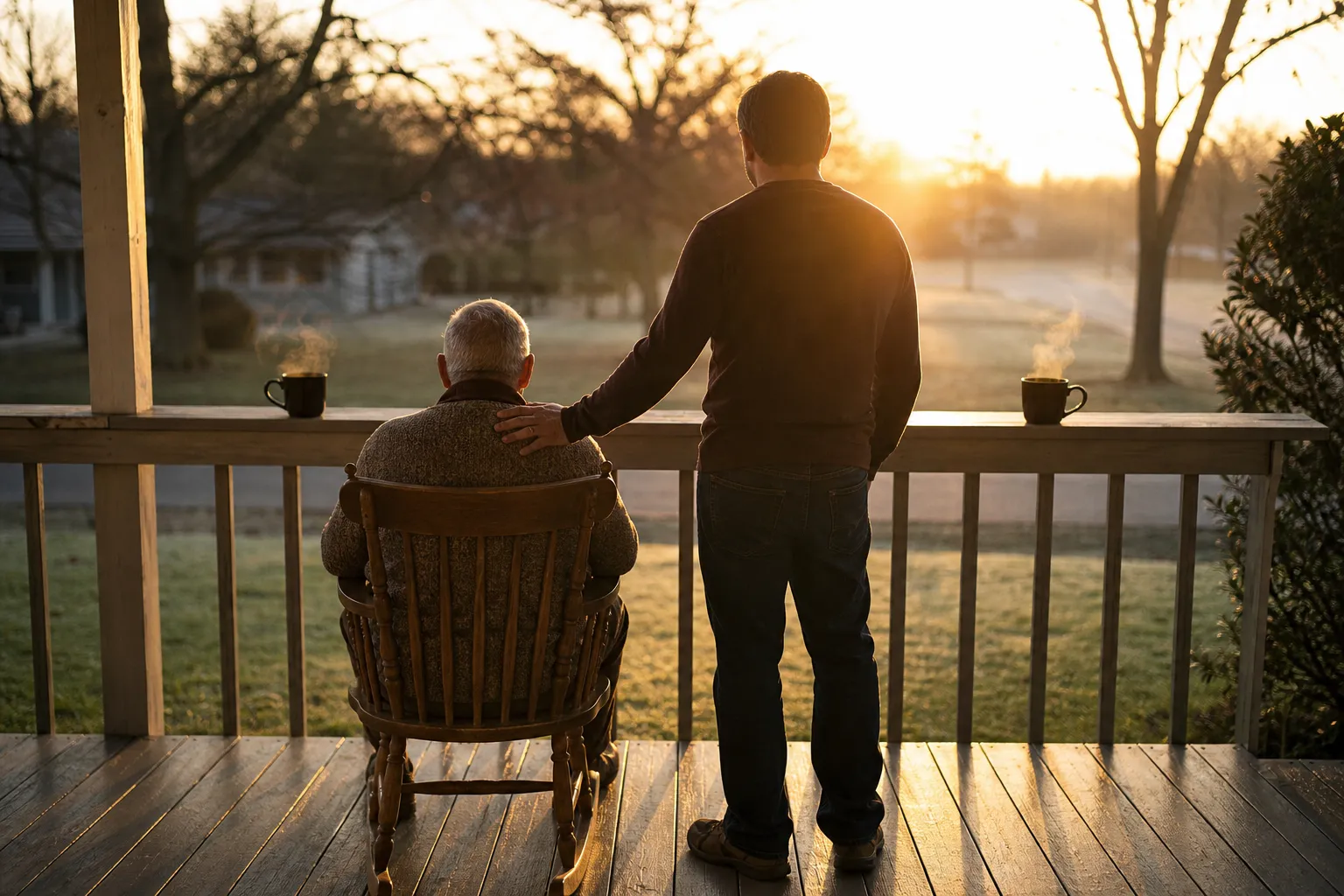
Quick answer: For many veterans, the hardest part wasn't the deployment — it was coming home. This section often surprises families more than the combat questions did.
After Service: The Rest of Your Life
Quick answer: Service shapes the decades after it as much as the years during. This section captures what veterans took with them, kept, changed, or left behind.
What You Saw That Most People Don't Know About
Quick answer: Some of the most important veteran stories are not combat — they're the strange, beautiful, ordinary, or absurd moments most civilians never hear about.
Reflection and Legacy
Quick answer: Save these for later in the project. They're the ones a veteran often hasn't been asked — and the ones their grandkids will replay.
Specific Notes by Era
Quick answer: Different generations of veterans have different cultural contexts. Your questions should respect those.
WWII veterans (now ~95+ years old): Time is the constraint. Even one 30-minute recording about basic training, their unit, and one specific friend is irreplaceable. They are dying at over 230 per day; many have never been asked. Ask soon, ask anything, record everything.
Korean War veterans (now ~90+): The "forgotten war." Many feel their service was overlooked by history. Asking specifically about Korea — the cold, the terrain, the Chinese forces, the civilians, the armistice — often opens decades of unspoken stories.
Vietnam veterans (now ~70-80): Came home to a country that mostly didn't want to hear it. Many have spent fifty years not telling. The homecoming questions in this list are especially important. Many also lost friends to suicide and Agent Orange in the decades after — Memorial Day questions matter for them well beyond combat losses.
Cold War / peacetime veterans: Often feel their service "doesn't count" because they didn't deploy. It does. Their training, their stations, the bases overseas, the equipment they kept ready — those stories are American military history too. Don't skip them.
Gulf War veterans (now ~50-60): Often the first to live with chemical exposure questions, fast deployments, and a fast war. Their stories are often more compressed but no less worth recording.
Post-9/11 veterans (Iraq, Afghanistan, GWOT, now ~30-50): Many have multiple deployments, complicated feelings about the wars themselves, and ongoing transitions. Many also still have friends actively at risk of suicide. Treat these conversations with care; many are still being processed in real time.
The Memorial Day Conversation: A 30-Minute Starter Set
Quick answer: If you only have one Memorial Day or Veterans Day window, ask these three in order. They're the fastest path to a recording your family will keep.
- "How did you end up in the service? What was that decision like?" — easy warmup, gets the timeline started
- "Tell me about the people you served with. Who do you remember most?" — opens the door to names, places, and the human core of the story
- "What do you wish more people understood about your service?" — almost always the question they've been waiting to be asked
Hit record before question one. Phone audio is fine. The recording your grandchildren will replay isn't the polished one — it's the one that exists.
Tips for Asking These Questions
Quick answer: Concrete first, follow the tangents, record everything, never push, never substitute thanks for listening.
Start concrete. Branch, basic training, MOS, ship, station — these are the anchors that unlock stories. Save the big questions for later.
Follow the tangents. If a question sparks an unexpected story, follow it. The most meaningful family stories often emerge from unplanned tangents, not scripted questions.⁷
Record everything. Memory fades fast. Phone audio is fine.
Don't push when they go quiet. That pause often comes right before the most important sentence of the day. Wait.
Make it a series. Three 45-minute sessions will get you more than one three-hour interview, and the veteran will enjoy it more.
Don't say "thank you for your service" as a closing line. Asking real questions is the deeper thanks.
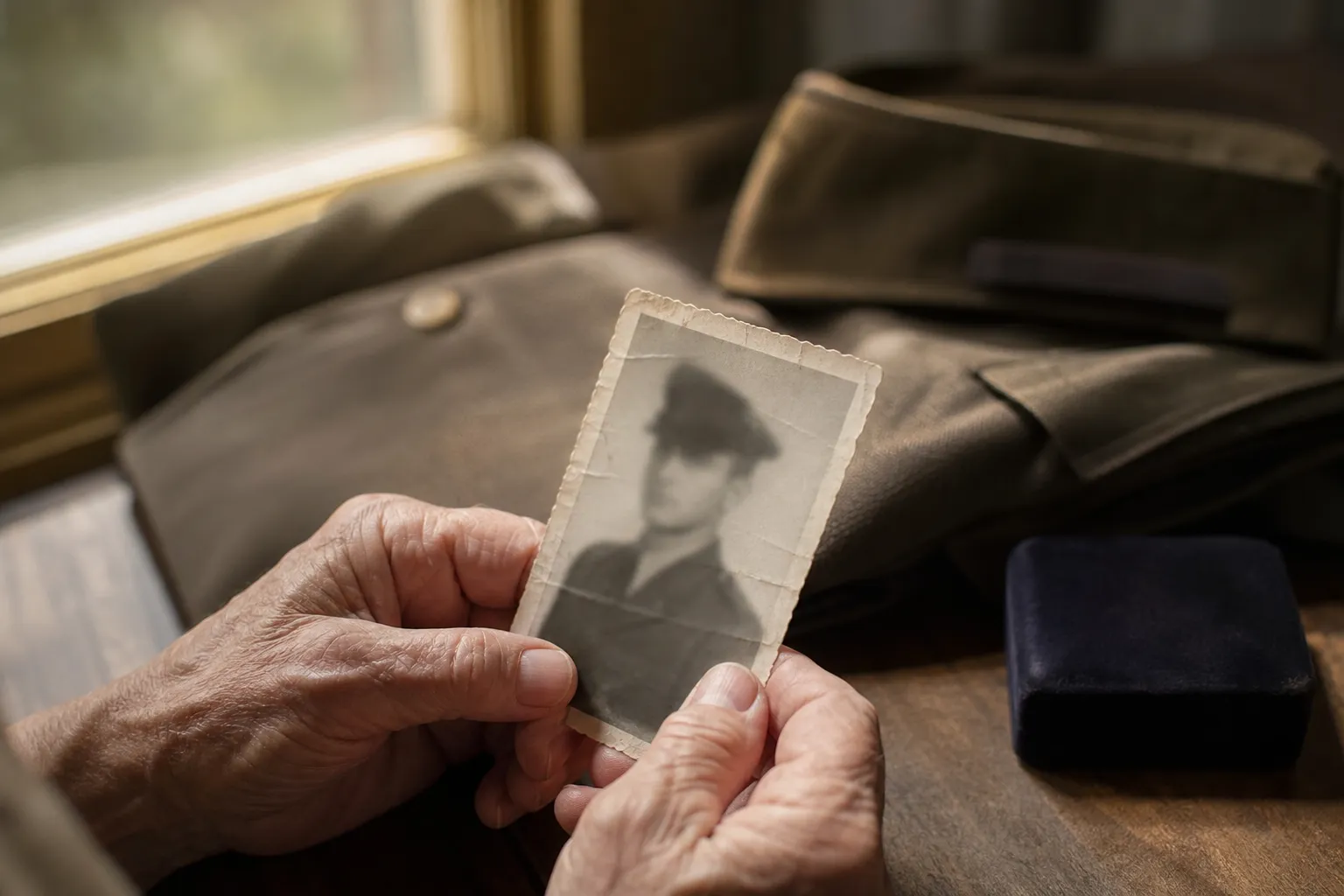
Ask about objects. Their dog tags, their unit patch, a photo, a letter, a ribbon — physical objects unlock the surrounding story.
For older veterans, run morning sessions. Energy and recall are typically best in the first hours of the day.
Related Guides
- Recording your parent's stories before it's too late
- Questions to ask your parents before they die
- 100+ Questions to Ask Your Dad
- 100+ Questions to Ask Your Grandparents
- The complete family legacy preservation guide
- Urgent story preservation: when time is short
- How to record family stories: the complete guide
You have the questions. Now you need 30 minutes, a phone, and the willingness to listen. Heritage Whisper turns the recording into a transcribed, organized archive your family can listen to forever — every word preserved, every name remembered, every voice kept.
Veterans Day, Memorial Day, or any Sunday afternoon. Hit record.
Keep his service in his own voice
Sources:
- Cognitive Interview Research — "The Cognitive Interview enhances long-term free recall of older adults," Psychology and Aging, 2006
- U.S. Census Bureau — Veteran population data; WWII veteran mortality rate from VA estimates
- Memorial Merits Survey — 47% of Americans regret not recording loved ones' voices (survey of 6,000+ Americans)
- Ebbinghaus Forgetting Curve — established psychology: memory fades approximately 50% within an hour without review
- StoryCorps — 645,000+ participants since 2003, with sessions averaging 40 minutes
- Military Cohesion Research — "Unit cohesion and PTSD in U.S. military veterans," peer-reviewed study on the long-term effect of unit bonds
- Frontiers in Psychology — "The role of intergenerational family stories in mental health and wellbeing," 2022
Frequently Asked Questions
What questions should I ask a veteran?
Start with how they ended up in the service (draft, enlistment, family expectation) and basic training — those are the safest universal warmups. Move into their job or MOS, where they were stationed, and the people they served with. Save combat, losses, and coming-home questions for later in the conversation, after trust is built. Most veterans have far more stories about training, daily life, and the people they served beside than about combat itself — and those stories are just as worth recording.
How do I get a veteran to open up about their service?
Ask specific, concrete questions instead of broad ones. 'What was basic training like?' works better than 'tell me about your time in the service.' Ask about their job, their unit, their best friend in the service, the food, the gear, the day they got out. Avoid the questions civilians always ask ('did you kill anyone?' or 'was it like the movies?') — most veterans have heard those a thousand times and shut down. The questions that actually unlock stories are the small, specific ones.
What should I ask a veteran on Memorial Day?
Memorial Day specifically honors those who died in service. The most meaningful questions are about the people they lost — by name, if they're willing to share. 'Who do you remember on Memorial Day?' 'Tell me about him.' 'What was he like?' For veterans who didn't lose anyone, ask about the brothers or sisters they served with: 'Who's the person you'd want my kids to know about?' Record the answer. Names and stories outlive grave markers.
What should I not ask a veteran?
Avoid 'did you kill anyone?', 'was it scary?', and 'what was the worst thing you saw?' as opening questions — they're the ones every veteran has been asked badly, and they shut conversations down. Don't push when they go quiet; the pause often means they're deciding whether to share something hard. Don't assume every veteran saw combat — most didn't, and the assumption can feel dismissive of what they actually did. And don't say 'thank you for your service' as a substitute for listening to one. Asking about their experience is a deeper thanks than the phrase.