Quick answer
To write a legacy letter, choose one person, explain why you are writing, share a specific memory, describe a lesson you learned and close with a hope for their future. Use your everyday voice. A few honest paragraphs can be enough, and you can share the letter now.
What a legacy letter can hold
A legacy letter gives someone a piece of your perspective: what you remember, what you have learned and what you hope they carry forward. It can be written for a child, grandchild, partner, friend or the wider family. You do not need a milestone or a perfect relationship to write a kind, honest message.
For this guide, the purpose is personal storytelling. Use the letter for memories, values and encouragement. Keep instructions about property, accounts or other formal arrangements in the appropriate separate documents.
You can share your letter now. Reading it together may lead to another story, a question or a conversation you would not otherwise have had. If you would rather keep it for a later occasion, label the intended reader and occasion clearly.
A simple five-part outline
1. Choose one reader. Write their name at the top. It is easier to find a natural voice when you can imagine speaking to one person instead of addressing every future generation at once.
2. Say why you are writing. Try an ordinary opening: “I have been thinking about the summers we spent together.” You do not need a grand announcement.
3. Tell one specific memory. Choose a moment that shows something about your relationship. Describe what happened, using details you actually remember.
4. Share a lesson and a hope. Explain what life taught you, including what you are still learning. Offer your hope without making it a rule the reader must obey.
5. Close in your own way. A familiar phrase, a thank-you or a simple expression of love is enough. Sign and date the letter.
The free template above follows this outline. The questions below can help you find material for it. Save any that fit, then use your personal reflection kit at the bottom of the page.
A memory to begin with
Small scenes make a letter personal. Choose one you would enjoy telling the reader face to face.
A lesson worth passing on
Your experience is most useful when it comes with its story. “Here is what helped me” leaves more room than “Here is what you must do.”
A hope for the reader
Leave room for the reader to become their own person. A legacy letter can offer belonging without setting conditions.
An example letter to a grandchild
The following is an original fictional example, not a customer letter. Use it to see the shape of a message, then write your own details.
Dear Sam,
I found the photograph of us planting beans in the little pots by the back door. You labeled every one, then asked whether they would know which names were theirs. I still smile when I think about it.
That afternoon reminded me of something I took a long time to learn: you can give something your care without knowing exactly how it will turn out. I spent too many years waiting to be certain before I began. Some of the best parts of my life started when I finally said, “Let's see.”
I hope you keep asking your questions. I hope you find people who listen to them. And when something does not grow the way you expected, I hope you let yourself plant again.
You do not have to make the choices I made to have a place in this family. I am glad I get to know the person you are becoming.
With all my love,
Grandma
Notice the progression: a shared scene, a personal reflection, a hope and a familiar closing. The letter does not try to contain an entire life. If another memory deserves its own letter, let it have one.
Make it sound like you
Read the draft aloud. If a sentence sounds like something you would never say, shorten it. Replace a general compliment with a moment that shows what you mean. Keep a little of your everyday rhythm instead of polishing away your personality.
Be thoughtful about unresolved conflict. A letter that demands forgiveness or assigns obligations can leave the reader with work they did not choose. If that is not what you intend, revise toward what you can own: your memory, your gratitude, your hope.
You can also speak the first draft. Use a prompt, record a short answer and listen back. Keep the recording if you want the reader to hear your voice alongside the words. Review any written version for accuracy before sharing.
Keep it somewhere it can be found
Put your name, the date and the intended reader on the letter. Keep a copy in a place you can find again, and tell someone you trust where it is if you want it shared later. For audio, use a descriptive filename and keep a separate backup.
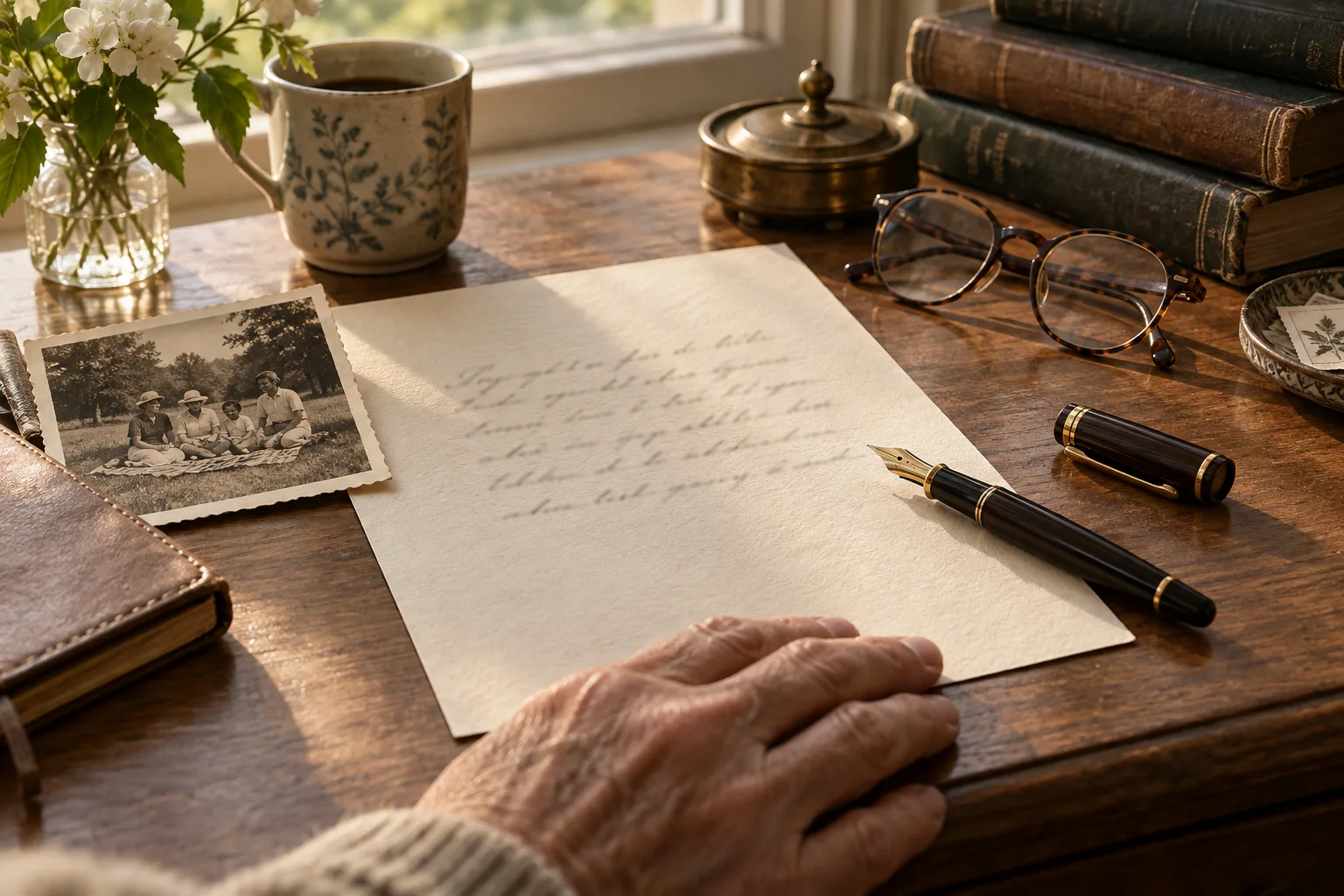
A handwritten note, typed letter and spoken message each carry something different. Choose the format that feels comfortable, or combine them. The point is to give your words a place to live.
For a longer account of your experiences, explore memoir writing prompts. To invite someone else to share their stories, use the family history interview kit. Our family legacy guide brings stories, photos and keepsakes together.
Frequently Asked Questions
What is a legacy letter?
A legacy letter is a personal message sharing memories, values, gratitude or hopes with someone you care about. You can give it to them now, keep it with family keepsakes or choose a future occasion to share it.
How long should a legacy letter be?
There is no required length. A few specific paragraphs can be enough: why you are writing, a memory, something you learned and a hope for the reader. Add more only when you have something you want to say.
Can I record a legacy letter instead of handwriting it?
Yes. Use the outline to guide a spoken message, or read a written version aloud. Keep the audio with the text, label it with your name and the date, and tell someone you trust where to find it.