
Recording Your Grandparents' Stories: A Complete Guide
How to record your grandparents' stories — even when you only see them at holidays, even when they live far away, even when they say their life isn't interesting. Practical guidance on equipment, setting, questions, sensitive topics, and building a multi-year archive.
This guide is for the adult children, grandchildren, nieces, nephews, and great-grandchildren who want to capture their grandparents' stories — and aren't sure where to start. It's a different project from recording an aging parent. Grandparents often live further away, you see them less often, they grew up in a more private generation, and they often resist with "oh, my life isn't that interesting."
This is how to start anyway, and how to keep going.
Quick Answer
How to record your grandparents' stories: Use your smartphone. Start at the next time you see them — Sunday dinner, a holiday, a phone call — with one specific question. Keep sessions to 30-45 minutes. Don't make them touch the device. Tell them you're recording and ask permission. Build the project across visits over months or years, not in one weekend.
Critical timing: The window narrows fast. 47% of Americans regret not recording their loved ones' voices.¹ Most never started at all. The single biggest predictor of whether you end up with recordings is whether you start. A 15-minute phone recording today is worth more than the perfect plan for six months from now.
| If you're working with… | Try this |
|---|---|
| A grandparent you see weekly | One short session per visit (15-30 minutes). The compound effect is enormous. |
| A grandparent you see at holidays | One 45-minute session per visit, plus a 15-minute recorded phone call between visits. |
| A grandparent who lives far away | Recorded video or phone calls. Pick a regular cadence — first Sunday of each month works. |
| A grandparent in declining health | See recording a dying parent's stories. Same principles apply. |
Start simple. Record everything. Don't wait for the perfect setup.
Why Grandparent Recordings Are Different
Quick answer: Grandparents tend to be more private, more modest, and grew up in a generation where you didn't talk about yourself. Don't take "oh, nobody wants to hear about that" as a real answer.
A few things make grandparent storytelling different from parent storytelling:
- Generational modesty. Many grandparents grew up in eras where talking about yourself felt rude. "Oh, my life isn't interesting" is reflex, not truth.
- More distance. You probably see your grandparents less than your parents — fewer chances, more pressure on each one.
- Less tech comfort. Most won't set up an app or troubleshoot a recording device. Your phone in your hand removes that barrier.
- More buried stories. They've spent decades not telling certain stories. The good ones are often deeper in.
- Different relationship dynamic. Grandparents and grandchildren often have a less-freighted relationship than parent-child. That works in your favor for getting them to open up.
These differences shape the whole project. Don't run it like a journalist interview — run it like a Sunday dinner with the recorder on.
You can just be their grandchild
You don't have to run the interview. Heritage Whisper records the conversation and asks gentle follow-up questions, so you can simply sit with them and listen.
Who Should Do the Asking
Quick answer: Whoever is closest, most patient, and willing to start. The "right" interviewer is the one who actually sits down and asks.
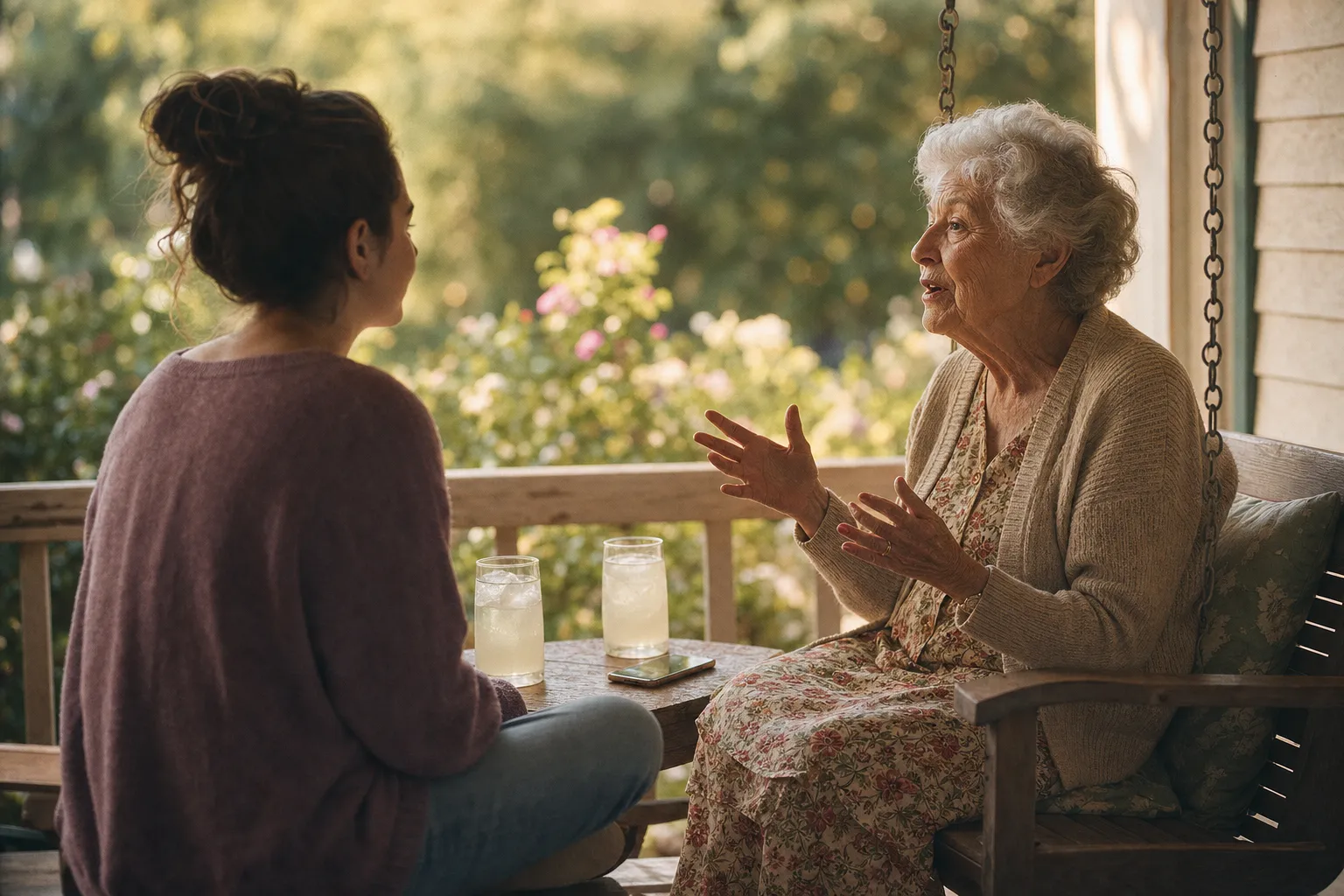
Grandkids often get more candid answers than grandparents' own children — there's less old conflict, less unfinished business, and a flattering newness to the asking. If you're a grandchild reading this and wondering whether you're the right person to ask: yes. You are.
That said, anyone can do this:
- Adult children know the family context best and can fill in names and dates.
- Grandkids often get the most emotionally open answers.
- Spouses of grandkids and great-grandkids sometimes get the freshest stories because the grandparent is showing off for the new family member.
If multiple people want to do it, divide topics — one of you takes early life, another takes career, another takes love and family. Combine recordings later.
Setting and Equipment
Quick answer: Their living room, your phone, no preamble. Skip the production. Most grandparents talk best in their own space.
Equipment: Your smartphone's built-in voice recorder app is plenty. Modern phones record audio at quality far better than what most families have ever needed. Simple smartphone recordings get completed far more often than elaborate video setups.²
If you want video, use the same phone propped on something stable. Don't introduce new tech.
Place: Their kitchen table, their living room, their porch. Their own space relaxes them. Avoid restaurants, busy rooms with TV in the background, and any place with a clock visible — many grandparents start watching the time without meaning to.
Time: Morning sessions, especially for older grandparents. Energy and recall are typically best in the first hours of the day. Avoid right after meals (sleepy) and late evenings (tired).
Position the phone: Place it on the table between you, mic side up, screen down or facing away. Don't hold it pointed at them like a microphone — it makes the recording feel like an interrogation.
Asking Permission (and Why It Matters)
Quick answer: Tell them you're recording. Most say yes, most are flattered, and the consent is part of the gift.
The conversation is short:
"Grandma, I'd love to record some of your stories so the family has them. Is that okay with you?"
Almost everyone says yes. Some grandparents are genuinely flattered to be asked — they've been waiting for someone to. Others are mildly self-conscious for about thirty seconds, then forget the recorder is on.
Don't record without asking. It betrays trust, and in some states it's illegal. The recordings you'll treasure most are the ones they knew about and chose to participate in.
How to Start the Conversation
Quick answer: With a specific concrete question, not a request to share their whole life. "Tell me about your first car" works. "Tell me about your life" doesn't.
Don't open with: "Tell me your life story."
Try opening with one of these instead:
- "What was your mother like?" (almost always opens grandmothers)
- "Tell me about your first car." (almost always opens grandfathers)
- "Where did you grow up? Walk me through the house."
- "How did you and Grandma meet?"
- "What was the day [my parent] was born like for you?"
Specific anchors unlock memory. Research shows 25-40% better recall with structured prompts versus open-ended ones.³
For deeper, organized question lists, see:
- 100+ questions to ask your grandma
- 100+ questions to ask your grandpa
- 100+ questions to ask grandparents
Pacing the Conversation
Quick answer: 30-45 minutes per session, then stop — even if it's going well. Tomorrow's session is part of the project.
Don't try to do it all in one sitting. **Families who record stories in shorter, recurring sessions capture significantly more content than those attempting marathons.**⁴
A few pacing principles:
- 30-45 minutes is the sweet spot. Long enough for real stories, short enough that energy stays good.
- End strong. Stop while they're still enjoying it, not when they're tired.
- Give breaks. If a session has been emotional or detailed, take a longer pause. Get water. Don't push through.
- Schedule the next one before you leave. "Same time next month?" — concrete next session beats vague "we should do this again."
Following the Tangents
Quick answer: When they drift off the question, follow them. The tangents are often where the best stories live.
If you ask "what was your first job?" and they end up telling you about a coworker they once had a crush on but never told anyone — let it happen. The most meaningful family stories often emerge from unplanned tangents, not scripted questions.⁵
Don't redirect them back to the question. The list of questions is a safety net, not a script. The recording is for stories, not for completing the list.
Questions That Specifically Work for Grandparents
Quick answer: Anchor questions in objects, places, and specific events from a long time ago. Distant memory often comes back more clearly than recent memory.
Grandparents often have stronger long-term memory than short-term. That works in your favor — your project is about long-term memory.
Questions that consistently unlock stories:
- "What was your kitchen like growing up?"
- "What did your dad do for work? What did a typical day look like for him?"
- "How did you and Grandpa/Grandma actually meet — not the short version, the long one?"
- "What was the day [my parent / your first child] was born like for you?"
- "What's a family member of yours I never met that you wish I had?"
- "What's a story your mother used to tell that I might not have heard?"
- "What's the biggest change you've seen in your lifetime?"
- "What do you wish more young people understood?"
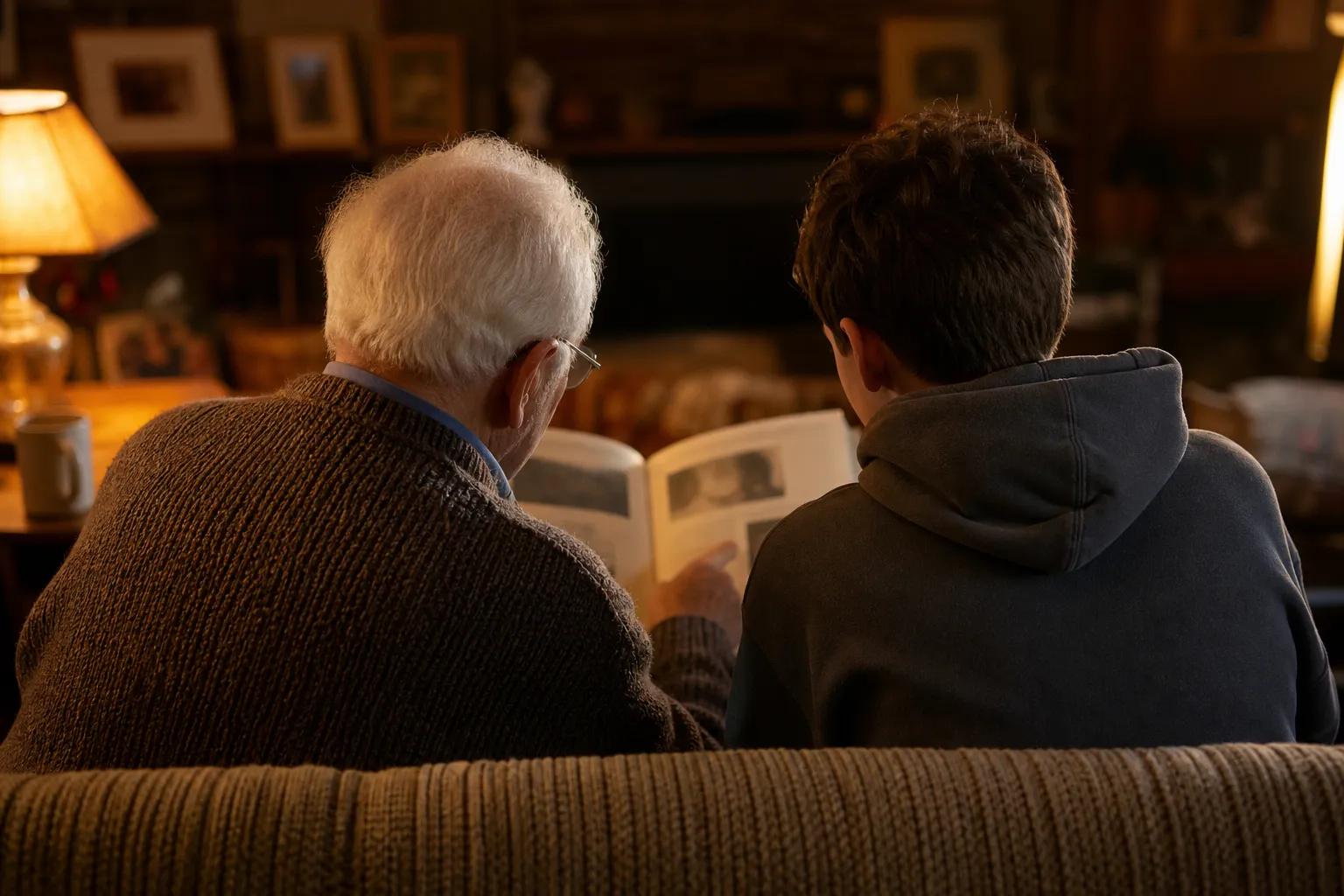
Use objects too. Hand them an old photograph. Ask "tell me about this picture" and let them go.
Sensitive Topics: How to Handle Hard Stories
Quick answer: If they share something painful, let them. Don't fix, don't argue, don't redirect. Just say "thank you for telling me that."
Old recordings sometimes surface old pain — a parent who left, a child who died, a war they don't want to discuss. Some principles:
- If they share something hard, don't fill the silence. Sit in it. The pause often means there's more coming.
- Don't argue or correct. Even if you remember an event differently, this is their memory of it.
- Don't promise to keep secrets. If they say "don't tell your mother," respond honestly: "I won't repeat this widely, but I might want to keep it in the recording." Let them decide if they want it on tape.
- If they go quiet on a topic, drop it. You can come back. Don't push.
- If they cry, sit with them. A tissue, a hand on the arm, no rush to "be okay." Let them feel what they feel.
If your grandparent declines a topic outright, just say: "Got it, I won't ask again." Then move on. Trust they may come back to it themselves later.
What If They Don't Live Nearby?
Quick answer: Phone calls and video calls work. Schedule a regular cadence and record them.
For long-distance grandparents:
- Pick a recurring time. "First Sunday of every month at 2pm your time" beats "we should talk more."
- Use speakerphone and a recording app. Most phones can record a speaker call. Voice memo apps work for video calls played out loud.
- Tell them at the start. "I'm recording today's call so I don't forget the details. Is that okay?"
- Keep calls shorter. 30 minutes by phone is plenty — it's harder to sustain on a call than in person.
- Ask one or two specific questions per call. Don't try to cover their whole life by phone.
The compound effect of monthly phone recordings over a year or two is enormous — and it captures their voice in casual conversation, not just formal interview mode.
What If You Only See Them at Holidays?
Quick answer: Make recording a holiday tradition. One 45-minute session per visit, and the project takes shape over years.
Most families see grandparents at Thanksgiving, Christmas, birthdays, and maybe summer. That's two to four visits a year. Treat each one as a chapter:
- Pick a quiet time during the visit. After breakfast, before dinner, while everyone else is doing dishes. Find 30-45 minutes.
- Plan ahead loosely. Pick a theme for that session — childhood at one visit, career at another, marriage at another. Don't try to cover everything in a holiday.
- Bring photographs. Old family photos are a shortcut to specific stories. Even 30 minutes of "tell me about this picture" captures hours of context.
- Record family meals casually. Even a 10-minute clip of them telling a story over dinner — captured on your phone with permission — is precious.
Two holiday visits a year × 45 minutes recorded × five years = seven and a half hours of family history. That is a substantial archive.
Backing Up and Sharing
Quick answer: Back up immediately to cloud storage and share with siblings the same day. Don't trust your phone alone.
Even enterprise hard drives have a 1.4% annual failure rate; consumer phones are far less reliable.⁶
After every session:
- Back up to the cloud. Google Drive, iCloud, Dropbox — pick one and stick with it.
- Share with at least one other family member. Send the recording to a sibling or your other parent the same day.
- Add notes while it's fresh. Names, dates, places mentioned. You'll forget within a week.
- Tell other family members what you captured. Even if they don't listen now, they'll remember it exists.
What to Do With the Recordings
Quick answer: Don't let them sit in your phone. Organize them, share them, and use a tool that transcribes.
Recordings only matter if they can be found and used. Some options:
- Heritage Whisper automatically transcribes recordings, organizes by chapter and decade, and shares each story with every family member's device the moment it's saved. The Memory Box stores associated photos, recipes, and letters.
- Google Drive folder + manual transcript. Free, but you do all the organizing.
- A printed book. PDF export from a digital archive, or a service like StoryWorth or Remento for prompt-driven keepsake books. Trade-off is structure vs flexibility — see our comparisons for the right fit.
Whatever you choose, organize as you go. A pile of 47 unlabeled audio files is a pile your grandkids won't open.
A Note on Grandparents Who Are Already Gone
Quick answer: It's not the same, but it isn't nothing. Voicemails, old videos, things they wrote — those are recordings too.
If you're reading this after a grandparent has already passed, look for:
- Saved voicemails. Many phones automatically save them. Scroll back through years.
- Old home videos with their voice in the background.
- Letters and cards in their handwriting.
- Other family members' memories of stories they told. Record those — second-hand stories are still family history.
For everyone else, every grandparent still living is a recording opportunity. Don't waste another holiday.
A Final Thought
You don't need to capture everything. You don't need professional audio. You don't need to ask the perfect question.
You need 30 minutes, a phone, and the willingness to ask one specific question and listen.
Start at the next visit. Record one story. Back it up. Schedule the next session. Build from there.
In ten years, the recording you made this month will be one of the most precious things your family owns.
Related Guides
- The best gift for grandparents (year-round)
- 100+ Questions to Ask Your Grandma
- 100+ Questions to Ask Your Grandpa
- 100+ Questions to Ask Your Grandparents
- 100+ Questions to Ask Your Aunt
- 100+ Questions to Ask Your Uncle
- 100+ Questions to ask a veteran about their service
- Recording your parent's stories before it's too late
- Questions to ask your parents before they die
- Urgent story preservation: when time is short
- How to record family stories
- The complete family legacy preservation guide
- How to save old photo albums
Heritage Whisper was built for exactly this — sit down with your grandparent, hand them the phone, and let Pearl guide the conversation with gentle follow-up questions while you just listen. Every family member gets the recording the moment it's saved, transcribed and organized by chapter.
You don't need to be the interviewer. You can just be their grandchild.
Keep your grandparent's voice forever
Sources:
- Memorial Merits Survey — 47% of Americans regret not recording loved ones' voices (survey of 6,000+ Americans)
- Based on Heritage Whisper experience working with families
- Cognitive Interview Research — "The Cognitive Interview enhances long-term free recall of older adults," Psychology and Aging, 2006
- StoryCorps — 645,000+ participants since 2003, with sessions averaging 40 minutes
- Frontiers in Psychology — "The role of intergenerational family stories in mental health and wellbeing," 2022
- Backblaze Hard Drive Stats — 1.4% annual failure rate across 340,000+ enterprise drives, 2025
Take the questions with you
Get the free 50-question guide families use to spark story conversations. We'll send it to your email.
Frequently Asked Questions
How do I start recording my grandparents' stories?
Start at the next time you see them — Sunday dinner, a holiday, a routine phone call — with one specific question and your phone's voice recorder. Don't wait for the perfect setup. The most common regret is not starting at all. A 15-minute recording on your phone, captured this Sunday, is worth more than the perfect plan you build for six months from now. Start small, record everything, and build from there.
How do I record grandparents who don't like technology?
Use your phone, not theirs. Most grandparents are perfectly comfortable being recorded — they just don't want to set up an app, learn an interface, or troubleshoot anything. You hold the phone (or place it on the table), hit record, and have a normal conversation. Never make them touch the device. If they ask, tell them honestly: 'I'm just recording so I don't forget the details. Is that okay with you?' Almost everyone says yes.
What if I only see my grandparents once or twice a year?
Treat each visit as a chapter, not the whole book. One holiday session of 30-45 minutes, captured every visit for several years, is a more realistic and effective project than trying to do everything in one weekend. Schedule phone or video calls between visits and record those too — even short calls capture their voice. The compound effect of small recordings over years is enormous.
Should I tell my grandparents I'm recording them?
Yes, always. Tell them simply: 'I'd love to record some of your stories so the family has them. Is that okay?' Most grandparents say yes — many are flattered to be asked. Hidden recording betrays trust and is illegal in some states. The recordings you'll treasure most are the ones they knew about and chose to participate in. Their consent is part of the gift.